Category Archives: Chosen People

the gospel geniza – part 2

removing leaven – preparing for the redemption

It is widely known that in Judaism there are actually two New Years.  The first month; Tishre, and the seventh month: Nisan. I

What is not as widely known is that there is a similar calendrical dialectic regarding when The Deliverance will arrive  in the time to come.

According to Rabbi Eliezer ‘In Nisan they were delivered’, as Scripture recounts. [but] ‘In Tishri they will be delivered in time to come’. This is learnt from the two occurrences of the word ‘horn’. It is written in one place, Blow the horn on the new moon, and it is written in another place, In that day a great horn shall be blown.

‘R. Joshua says, In Nisan they were delivered, [and] in Nisan they will be delivered in the time to come’. Whence do we know this? — Scripture calls [the Passover] ‘a night of watchings’, [which means], a night which has been continuously watched for from the six days of the creation. (Rosh HaShana 11b). II

Given the solemnity of Rosh Hashanah (the Tishre New Year), it is no surprise that preparations begin a month before at the beginning of Elul with the daily Selichot prayers and blowing of the ‘horn’.  The days of preparation and repentance culminate on Yom Kippur when the Shofar horn is blown one final time and the judgment has been sealed and the gates closed – Neilah.  All in all, there is a 40 day period between the beginning of Elul wherein the Jewish People prepare for the Day of Judgment, and according to Rabbi Eliezer for deliverance.

What is surprising is that there is not a similar 40 day period preceding Passover.

There seem to be artifacts for such a long preparation period in the four special Sabbaths (Shekalim, Zachor, Parah and HaChodesh) which create a roughly 40 day preparation period to Passover. III But where is the sense of angst and spiritual growth, the repentance and increased sense of expectation and spiritual frenzy that one would expect to lead up to deliverance and that one finds in the Tishre parallel?

It’s not as if the Bible does not allude to such preparation.  There are probably more references to the removing leaven than there are to any other aspect of the holiday.

3 Thou shalt eat no leavened bread (חָמֵץ) on it; seven days shalt thou eat unleavened (מַצּוֹת) bread therewith, even the bread of affliction; for in haste didst thou come forth out of the land of Egypt; that thou mayest remember the day when thou camest forth out of the land of Egypt all the days of thy life.

4 And there shall be no leaven (שְׂאֹר) seen with thee in all they borders seven days; … (Deuteronomy 16: 1 – 4)

לֹא-תֹאכַל עָלָיו חָמֵץ, שִׁבְעַת יָמִים תֹּאכַל-עָלָיו מַצּוֹת לֶחֶם עֹנִי:  כִּי בְחִפָּזוֹן, יָצָאתָ מֵאֶרֶץ מִצְרַיִם–לְמַעַן תִּזְכֹּר אֶת-יוֹם צֵאתְךָ מֵאֶרֶץ מִצְרַיִם, כֹּל יְמֵי חַיֶּיךָ.

וְלֹא-יֵרָאֶה לְךָ שְׂאֹר בְּכָל-גְּבֻלְךָ, שִׁבְעַת יָמִים; וְלֹא-יָלִין מִן-הַבָּשָׂר, אֲשֶׁר תִּזְבַּח בָּעֶרֶב בַּיּוֹם הָרִאשׁוֹן–לַבֹּקֶר.

I would argue, that as a result of Christianity monopolizing the Passover deliverance narrative, Judaism dialed down both the preparations and build-up to Passover as well as the inherent messianistic overtones of the holiday. (see my previous post: the gospel geniza and Daniel Boyarin’s  Border Lines: The Partition of Judaeo-Christianity) IV

What was lost or at least de-emphasized from Judaism was the connection between removing leaven and cleaning one’s soul in preparation for redemption.

The New Testament mentions “the leaven of malice and wickedness”

Therefore let us keep the feast, not with old leaven, neither with the leaven of malice and wickedness; but with the unleavened [bread] of sincerity and truth. [Corinthians 5:8]

This view is shared by the ancients:

“Leaven itself comes from corruption, and corrupts the dough with which it is mixed . . . and in general, fermentation seems to be a kind of putrefaction” (Plutarch, Quaest. Rom. 109). Plutarch records that the Roman high priest (Flamen Dialis) was forbidden even to touch leaven (ibid.). To be sure, all of the above-cited references stem from late antiquity (Christian, rabbinic, and Hellenistic sources), but they undoubtedly reflect an older and universal regard of leaven as the arch-symbol of fermentation:’ deterioration, and death and, hence, taboo on the altar of blessing and life. [pp 188-9 Leviticus 1-16: A New Translation with Introduction and Commentary Anchor Bible, Vol. 3, Jacob Milgrom]

Listen to what (Pre-Christian) Philo of Alexandria (representing the Jewish Hellenistics) wrote:

Leaven is forbidden because of the rising which it produces. Here again we have a symbol of the truth, that none as he approaches the altar should be uplifted or puffed up by arrogance; rather gazing on the greatness of God, let him gain a perception of the weakness which belongs to the creature, even though he may be superior to others in prosperity; and having been thus led to the reasonable conclusion, let him reduce the overweening exaltation of his pride by laying low that pestilent enemy, conceit. …. For naked you came into the world, worthy sir, and naked will you again depart, and the span of time between your birth and death is a loan to you from God. During this span what can be meet for you to do but to study fellow-feeling and goodwill and equity and humanity and what else belongs to virtue, and to cast away the inequitable, unrighteous and unforgiving viciousness which turns man, naturally the most civilized of creatures, into a wild and ferocious animal! (Philo,The Special Laws, Book I, 293-295 quoted in The Passover Anthology, Philip Goodman).

It is surprising that the symbolism of the purging of leaven as a metaphor for introspection and repentance seems not to appear in the Haggada directly itself and is relegated (if at all) to the commentaries as meta-interpretation.  In fact, the removal, nullification and prohibition to own leaven is not mentioned during the Seder service at all… surprising since at least half of the effort in preparing a seder goes into making the home hametz-free! (“On all other nights we eat Hametz and matzo .. on this night we eat only matzoh” does not count.. since the emphasis is on commandment of eating matzoh, not clearing and nullifying hametz.)

If we enlarge our search for spring spiritual cleaning, beyond Christianity, we should note that Persians at the outset of the Iranian Norouz, (the Persian new year, which falls on the first day [Rosh Hodesh) of spring) continue the practice of “khooneh tekouni” which literally means “shaking the house”? Everything in the house is thoroughly cleaned, from the drapes to the furniture.

Back to the Christian geniza, we should note that Lent comes from the word length.. as in the longer days of spring. Instead of Ash Wednesday, the Eastern Church celebrates Clean Monday, otherwise known as Ash Monday. According to Wikipidia:

The common term for this day, “Clean Monday”, refers to the leaving behind of sinful attitudes and non-fasting foods. It is sometimes called “Ash Monday,” by analogy with Ash Wednesday (the day when the Western Churches begin Lent). …. Liturgically, Clean Monday—and thus Lent itself—begins on the preceding (Sunday) night, at a special service called Forgiveness Vespers, which culminates with the Ceremony of Mutual Forgiveness, at which all present will bow down before one another and ask forgiveness. In this way, the faithful begin Lent with a clean conscience, with forgiveness, and with renewed Christian love. The entire first week of Great Lent is often referred to as “Clean Week,” and it is customary to go to Confession during this week, and to clean the house thoroughly.

The fact that so many other competing religions, especially Christianity, retained the spring-purification rites may explain why it’s symbolism became muted in Judaism.

But the New Testament preserves another sense of leaven, namely the polemical – vindictive tool of calling one’s enemy leaven.

“the leaven of the Pharisees,” which is “hypocrisy” (Luke 12:1; d. Mark 8:15).

It would seem that in Judaism, the inward-looking cleaning of sin in preparation for redemption was de-emphasized, just as the outward-looking cleaning of one’s enemies was emphasized.

“Sovereign of the Universe, it is well known to You that it is our will to do Your will. Who prevents us from doing so? The leavening agent in the dough (the evil inclination within us) and our subservience to the nations. May it be Your will to save us from these so that we can return to fulfilling Your commandments wholeheartedly.” Prayer of Rabbi Alexandrai (quoted by Milgrom ibid).

See also the kabalistic kavanah recited before the bedikat HaChametz (searching for the Leaven):

May it be Your will, Lord, our G-d and G-d of our fathers, that just as I remove the chametz from my house and from my possession, so shall You remove all the extraneous forces. Remove the spirit of impurity from the earth, remove our evil inclination from us, and grant us a heart of flesh to serve You in truth. Make all the sitra achara, all the kelipot, and all wickedness be consumed in smoke, and remove the dominion of evil (Memshelet Zadon – Christians [?])  from the earth. Remove with a spirit of destruction and a spirit of judgment all that distress the Shechina, just as You destroyed Egypt and its idols in those days, at this time. Amen, Selah.

bedikat Hametz kavanah

As long as Christianity and Judaism were in conflict, I can understand why the month long  spiritual cleaning was relegated to the day before the holiday and does not appear in the Hagaddah. I can also understand the institutionalization of “a comprehensive religious ideology that sees vengeance as a central component in its messianic doctrine. (Yuval p. 123).

With the Christian embrace of Lent and Holy Week and the heightened levels of expectation, spiritual frenzy and expectations of rapture approaching their Pascha (Easter), we Jews de-emphasized our own versions of these same expectations for Passover.  We did this for philosophical but also practical reasons.  The Easter period was historically a dangerous one for the Jewish minority.

It seems to me that the only part of cleaning the leaven to survive in our Hagaddah was in the “Pour out your Wrath on the nations”.

Pour out Your wrath upon the nations that do not acknowledge You, and upon the kingdoms that do not call upon Your Name. For they have devoured Jacob and laid waste his habitation. Pour out Your indignation upon them, and let the wrath of Your anger overtake them. Pursue them with anger, and destroy them from beneath the heavens of the Lord.

sephoch hamatcha

This is actually a high-point of the Seder dinner; when we open the door to welcome Elijah and before we drink the Fourth Cup which is traditionally the cup of redemption.  At this pivotal moment we beseech God to clean the world of our external enemies (leaven).

Now that the competition is over, it is time to replace the “pour out your wrath” and it’s emphasis on external polemics and vengeance, with a reference to the internal cleansing that must precede redemption.

In fact, a “Rabbi Shimon ben Yitzhak wrote a poem cursing the “evil impulse” that was stylistically similar to the curse against the Gentiles. This liturgical poem continues alphabetically; the verbs used to curse later on are “sweep him away, hurl him, compel him, banish him, sacrifice him” (see A. M. Haberman quoted in Two Nations in Your Womb: Perceptions of Jews and Christians in Late Antiquity and the Middle Ages by Isræl Jacob Yuval. Pp 123-4)

————-
In a private correspondence with Israel Yuval he writes:

“The English translation of my book omitted quotations from the piyyutim, because of the difficulties in their translation. As mentioned in footnote 91, the piyyut which curses the evil impulse was printed in Haberman’s edition p. 148 (קמח):
אווילי (=יצר הרע) המתעה מרגיז ומחטיא / בלעהו קלעהו ועוד בל יסטיא
געול המגאל ומטנף טהורים / דחהו מחהו מלבות והרהורים
הותל המהתל ומפתל ישרים / וכחהו שכחהו ולא יקמו אשרים
זבוב המארב במפתחי הלב / חנקהו נקהו ולב חדש תלבלב

Trans. Hillel ben Sasson:

Foolish (=evil impulse) who sets astray, aggravates and causes to sin \ swallow it (the evil impulse), tie it, so that it will not bedevil you,
drive away the one who’s impure [not sure ‘impure’ is precise but it’s close enough] and brings filth upon the pure\ reject him, erase him from hearts and thoughts
confuse the one who confuses and makes the straight ones crooked\ argue with him, forget him so that idols will not be erected
the insect who lurks in the doors of the heart \ suffocate him, cleanse him and a new heart you will cause to blossom

Hillel ben Sasson also suggests:
שפוך אהבתך, הוספה שנמצאה בכתב יד של הגדה לפסח מ-1521 המיוחסת לנכדו של רש”י

שפוך אהבתך על הגויים אשר ידעוך ועל ממלכות אשר בשמך קוראים בגלל חסדים שהם עושים עם זרע יעקב ומגינים על עמך ישראל מפני אוכליהם. יזכו לראות בסוכת בחיריך ולשמוח בשמחת גוייך.

Trans. GS

“Pour out Your Love” an addition that was found handwritten in a 1521 Passover Hagadah attributed to Rahi’s grandson:

“Pour out Your love on the nations that have known you and on the empires who call out in Your name, by the merit of the rightious that work with the seed of Jacob and protect them from those that would devour them. May they merit in the tabernacle of your Chosen and to rejoice in the joy of your people.”
————

As long as we’re re-introducing and re-emphasising the internal removal of leaven, let’s note that most haggadot, don’t start with kiddush, but rather retain the home ceremony of searching for the leaven… even though the search and nullification of leaven takes place before the onset of the holiday and holiday service.

The message is clear: The nullification of the leaven/decay is critical for the freedom that is to follow. Let’s use this text and a revised, internalized “pour out thy wrath” to discuss how we need to prepare for redemption, in whatever form we envision it…. by removing the leaven from our hearts, including the outdated religious ideology of redemption through polemic and vindication.

Leaven-Logo official-200

—————–

I Tishre, the first month in the Fall and Nisan the seventh month in the Spring.  Tishre, because the world was created in Tishre and Nisan because the Jewish people were created in Nisan and because the Bible in Exodus 12:2 says so “This month shall be unto you the beginning of months; it shall be the first month of the year to you.”

II See also Megillah 6b: Where Rabbi Gamaliel argues that in a leap year, Purim is celebrated on the 2nd Adar: “R. Simon b. Gamaliel again reasoned: Just as in most years [we think of] Adar as adjoining Nisan, so here [we keep the precepts] in the Adar which adjoins Nisan. …. The reason of R. Simon b. Gamaliel is that more weight is to be attached to bringing one period of redemption close to another.” Purim and Passover are times of future redemption.

III Or if one counts from Purim, a roughly 40 day period between Purim and the end of Nissan (which marks the end of when the deliverance will come).

IV In an ironic use of replacement theology, the Rabbis elevated an agricultural holiday (Shavuot) into a holiday of revelation (of the Torah) and similarly modified the 49 day Omer period between Passover and Shavuot, into a new period of purification and preparation.

end note –

Just as the Kol Nidre nullification of vows prior to the onset of Yom Kippur is forever connected to the service to follow, so too, the Kol Hamirah is critical to the seder to follow. Both nullification (Bitul) formulas are legal in form and in the Aramaic vernacular. Both are combined with an invitation for others to participate, and both are intrinsic to the holiness of the coming day. The ironic difference is that Kol Nidre is famous and Kol Hamirah is not… but that the nullification of Hametz is of biblical origin (and requires a blessing) while Kol Nidre is of unknown origin. Most unfortunatley, Kol Nidre has a soulful tune and Kol Hamira has none….

1 Comment

Filed under Bible, Chosen People, Jewish jesus, Judaism, Religion, social commentary, Torah

the gospel geniza

getting ready for passover

In the category of Jewish-Christian Dialogue, the award for the best back-handed compliment goes to Pope John Paul II who in 1986 went to a Rome synagogue to pray with the city’s Jewish community. Noting Christianity’s unique bond with Judaism, he said, “You are our beloved brothers … you are our elder brothers” in the faith of Abraham. (see: Catholic News). More recently, Pope Francis described the Jewish people as the “big brothers” of his Roman Catholic flock in words of solidarity marking the 75th anniversary of Kristallnacht.

Why a compliment? Because we Jews are raised with a conceit… that Christians cannot possibly understand their religion without understanding Judaism, the religion of Jesus. We may be a minority and have been oppressed, but when all is said and done, our religion preceded and gave birth to Christianity… the two popes exploited this conceit.

Why a backhanded compliment? For those familiar with the Hebrew Bible, you know that the God of the Jews favors the younger brother.. from Cain and Abel until King David and on….

and the elder shall serve the younger. (Genesis 25: 23)
וְרַב יַעֲבֹד צָעִיר

For a complete analysis of the history of this birth-order election tug-of-war see the brilliant: Two Nations in Your Womb: Perceptions of Jews and Christians in Late Antiquity and the Middle Ages by Isræl Jacob Yuval.

Why the Award and why now? Now that Christianity and Judaism are getting along so well, we can both agree that neither religion can achieve self-awareness without understanding the other. Both religions can lose their conceits and sense of election and need to admit that they both do not have a well thought out theology which includes the other. *

As Daniel Boyarin argues in his book Border Lines: The Partition of Judaeo-Christianity, both Rabbinic Judaism and Christianity were created in the chaos formed by the loss of the temple and the Jewish Commonwealth in the first centuries of the Common Era. And…. it turns out, both “religions” increasingly defined themselves in counter distinction to the other.

For the purposes of the present discussion, what this means is that both faiths jettisoned beliefs held by the other. So in his more popular book, The Jewish Gospels, Boyarin argues that if the early Christians were looking to convince Jews of their authenticity, it would hardly make sense to cite unheard of concepts and novel ideas to prove that they were the true heir to the throne. If they claimed that Jesus was divinely born and/or needed to be sacrificed, Boyarin argues, that must have been the expectation of the general Jewish population of the day. Similarly, if early Christian Jews claimed that the Godhead had multiple manifestations, then this belief must have been resident among fellow Jews. And in his writings, Boyarin proves that these beliefs were in fact, held by Jews of the time.

As the break between the two religions grew over time, the border lines became less porous. Previously common beliefs, rituals and traditions were divvied up as in a zero sum game.

So the two Popes have my appreciation for reminding me of a once important thread in my tradition, the election of the younger brother, which we jettisoned at the border and had forgotten about to the point where most of us smile with appreciation when we’re referred to by the leader of the Catholic Church as the older brother.

The two Popes get my appreciation, because in our new world where hostilities have ceased and Jewish Christian dialog is fashionable, we Jews are now free to roam around the Gospels (and the rest of Christian scripture, liturgy and literature) to reclaim customs, traditions, rituals, expressions, beliefs and even polemics that we discarded and buried long ago in what I call the Gospel Geniza.

In my next post we’ll explore this treasure trove, hiding in plain sight, for Jewish artifacts that impact the Passover celebration.

Here are some entrées to whet your appetite:

Shabbat Hagadol – see John 19:31 (megalē μεγάλη which means: large, great)
Hametz – See Mark 8:15 “the leaven of the Pharisees and of Herod” and the connection between purging leaven and repentance.
Afikomen – broken and hidden, a symbol of the messiah and a lost polemic

fish

* i.e Christians, especially Catholics, have not fully worked out how their older brother need not be rejected and replaced by the younger brother for their new testament (covenant) to be valid, and Jews have not expanded their rudimentary category of natural religion (Noachide Religion) to include other eschatological monotheistic religions such as Christianity which have valid but alternative conceptions of the Godhead and end-of-days.

2 Comments

Filed under Bible, Chosen People, divine birth, Hebrew, Jewish jesus, Judaism, Religion, resurrection, Sabbath, Shabbat, social commentary, Torah

purim torah

purim

Did you know that on Purim we celebrate the acceptance of the Torah.

The Talmud reveals that the original acceptance of the Torah at Mt. Sinai, was under duress and therefore non-binding:

And they stood under the mount (Exodus 19:17)

וַיִּתְיַצְּבוּ, בְּתַחְתִּית הָהָר

R. Abdimi b. Hama b. Hasa said: This teaches that the Holy One, blessed be He, overturned the mountain upon them like an [inverted] cask, and said to them, ‘If ye accept the Torah, ’tis well; if not, there shall be your burial.’ R. Aha b. Jacob observed: This furnishes a strong protest against the Torah. Said Raba, Yet even so, they re-accepted it in the days of Ahasuerus, for it is written, [the Jews] confirmed, and took upon them (Esther 9:27) what they had already accepted.

ויתיצבו בתחתית ההר, אמר רב אבדימי בר חמא בר חסא: מלמד שכפה הקדוש ברוך הוא עליהם

את ההר כגיגית, ואמר להם: אם אתם מקבלים התורה – , מוטב ואם לאו – שם תהא קבורתכם. אמר רב אחא

בר יעקב: מכאן מודעא רבה לאורייתא. אמר רבא: אף על פי כן, הדור קבלוה בימי אחשורוש . דכתיב

קימו וקבלו היהודים, קיימו מה שקיבלו כבר

[Babylonian Talmud: Tractate Shabbath 88a]

One wonders what was going through Raba’s mind that Purim popped into his head in terms of the final acceptance of the Torah…. What was he thinking… or drinking?[i]

Maybe Raba was on to something.  There’s something special about Purim and the Esther Megillah. Purim is the last Biblically ordained holiday and the scroll that we read on the evening and morning of Purim is actually the last book of the Torah.  Could it be that for Raba, Purim and the Book of Esther represented the last chapter, the Jewish people’s last chance and God’s last word? Could it be that for Raba, Purim celebrates the last echo of revelation?

If we are right, then Raba’s association of Purim with the acceptance of the Torah is both profound and ironic given that the Book of Esther’s claim to fame was so tenuous. Megilat Esther does not contain God’s name, was not written in or mention the Promised Land of Israel and includes highly unorthodox behavior including Esther’s marriage to a non-Jew, probable ingestion of non-kosher food (Megilah 13a) and no reference to any Jewish practices or the Temple. [ii]  It’s inclusion in the Canon (Torah, Prophets and Writings – Tanakh) was openly debated. [iii]

To my mind, the winning Talmudic argument for including the Scroll of Esther in the canon of the Hebrew Bible provides an insight into Raba’s understanding of the last revelation.

The Talmud[iv] asks “What is the source in Torah for Esther?  And cites Deuteronomy 31:18  “I will surely hide my face from you on that day” playing on the meaning of the name “Esther” to hide.

In a brilliant essay, Richard Elliot Friedman identifies the underlying plot of the Hebrew Bible.  He writes:  “Specifically, the major unifying component of the biblical plot is the phenomenon of the continually diminishing apparent presence of Yahweh among humans from the beginning of the book to the end, the phenomenon of Deus absconditus or, in the book’s own terms, Yahweh hammastir panav [hiding my Face]…”. Over a number of pages, Friedman shows how there is a clear transition, from Eden, when God takes care of everything through Noah, where Noah must build his own ark and to Jacob where Jacob must steal his own birthright. “Something is happening. For whatever reason, Yahweh is transferring (relinquishing?) ever more control of the course of human affairs to members of the human community.”

“In Moses’ own time, ..the people’s experience of the divine is mediated through Moses, or “masked” through the Kabod [glory] and the anan [cloud], or channeled through a series of layers…. Finally, Yahweh’s last words to Moses before summoning him to Abarim, he says, “I shall hide my face from them..” “After Moses, prophets are to experience only dreams and visions….” [v]

Commenting on The Book of Esther, he writes: “The narrative from Genesis to Esther has come full cycle from a stage on which God is alone to one on which humans are on their own. Through no longer in control of miraculous powers, humans have arrived at complete responsibility for their fortunes.”

For my fellow Feminists, interested in the connection between Eve and Esther go to the footnote[vi], but be assured that the Humantasch is the antidote for the Apple of Eden!

(see The Hiding of the Face: An essay on the literary unity of Biblical Narrative, by Richard Elliot Friedman in Judaic Perspectives on Ancient Israel ed Jacob Neusner Wipf and Stock publishers 1987).

On Purim, let’s celebrate the final giving and acceptance of the Torah. The lesson of reading the Esther Megillah with a blessing (the only one of the Ketuvim to be read with a blessing)  is to finalize what began at Sinai. On Purim we accept the end of revelation and the end of magical thinking and complete acceptance of our responsibilities as humans. We masquerade to remember, that at this giving of the Torah, we do not see or hear God, He is hidden from us and maybe we from Him. We exchange food with each other in the way that two lonely humans touch. Whether lovers, neighbors or strangers, that touch, hug or deliver a box of welcome-brownies we show that we are not alone. We experience real Simcha knowing that we as a people and as individuals have survived against all odds. And….  and like survivors since Noah after the flood… we might need a drink.  And finally, we celebrate women.. who may get us into trouble.. but more often… like Esther… save us.

Purim as a holiday celebrating the acceptance of the Torah, is transformed.  Think of the audience participation… the shouting, cheering and booing as a variation, maybe an improvement on the custom to solemnly stand as the Ten Commandments are read. Look to the side at the cross-dressing Jew standing next to you, and reflect that now that we are all alone, we are also all together, and yes, we all stood at Sinai and maybe we didn’t look that different than this crazy mixed multitude in attendance.

L’Chaim!

Esther


[i] As long as we’re connecting the story of Purim to the giving of the Torah, we might as well mention the Fast of Esther.

Before Esther goes, uninvited to the King to  plead for the Jews she tells Mordechai:

‘Go, gather together all the Jews that are present in Shushan, and fast ye for me, and neither eat nor drink three days, night or day; I also and my maidens will fast in like manner; and so will I go in unto the king, which is not according to the law; and if I perish, I perish.’ (Megilat Esther 4:16)

A three day fast appears in only one other place:

And the LORD said unto Moses: ‘Go unto the people, and sanctify them to-day and to-morrow, and let them wash their garments, and be ready against the third day; for the third day the LORD will come down in the sight of all the people upon Mount Sinai. (Exodus 19: 12)

[ii] see A Jewish Reading of Esther, Edward L. Greenstein, pp 231 – 233 in Judaic Perspectives on Ancient Israel ed Jacob Neusner Wipf and Stock publishers 1987.

[iii] Reb Judah said in the name of Samuel “The scroll of Esther does not defile the hands (unlike a Sefer Torah) and as such was not divinely inspired [Megilah 7a). “All of the Hebrew scripture is represented at Qumron (Dead Sea Scrolls) except for the Scroll of Esther [and] it is possible that the sectarians did not observe the Purim festival and rejected the book which enjoins its observance. (see pp 106-107, 113 – 114 and note 301, The Canonization of the Hebrew Scripture by Sid Z. Leiman, Archon Books, 1976)

[iv] Hullin 139b

[v] The last major public miracle… is that of Elijah at Carmel (Kings 1:19). … In a fascinating juxtaposition.. is followed by the portrayal of Elijah at Horeb. Again we see a lone prophet on Horeb/Sinai, but Elijah’s experience there is a reversal of Moses. In the place of the supreme theophany come three phenomena… (earthquake, wind, and fire), each followed by the specific qualification “Yahweh was not in (it),”.. With the destruction of the Temple at the conclusion of the Book of Kings, the last channel is removed. The prediction that Yahweh’s face will be hidden is fulfilled… Yahweh plays no apparent role whatever in the Books of Ezra and Nehemiah, and he is not mentioned in Esther.

[vi] Friedman continues: “Seen in the light of the increasing responsibility ascribed to humans through the course of the narrative, Esther is no less interesting,… Woman, Eve, has been blamed for millennia for entering upon the course of action that brought humans out of their initial state of harmonious relations with Yahweh (Genesis 3). It seems only fair, ironic, and appropriate that the narrative concludes with a story in which humans, now in a world, in which the presence of god is hidden, turn to a woman as their chief hope of rescue. One may interpret the Eve-to-Esther connection differently, but one can hardly ignore it. Each of the Bible’s bookends has a woman’s face carved on it.”

Leave a comment

Filed under Bible, Chosen People, Hebrew, Israel, Judaism, magic, miracle, Religion, social commentary, Torah, women's rights

thou shalt not play small

Parshat Ki Tissa – Valentine’s Day

The sin of the Golden Calf was not a sin against God, but rather a sin against man. Theirs was not a sin of idol worship but of hero worship.  It was not God that was being replaced but man, in the guise of Moses.  Moses had disappeared for a rendezvous with an unseen God and these new-Jews had been left alone.  They took Moses as an intermediary with God and the Calf was to replace their mis-taken Moses.

And Aaron said: ‘Let not the anger of my lord wax hot; thou knowest the people that they are set on (or in) evil. So they said unto me: Make us a god (Elohim – alt. power), which shall go before us; for as for this Moses, the man that brought us up out of the land of Egypt, we know not what is become of him. (Exodus 32, 22-23)

term1

term2

Their’s was not a misconception in the form or role of God, it was rather a misunderstanding in the newly defined purpose and powers of man. Theirs was not a lack of faith in God, rather it was in man that they were short on faith.

These newly liberated Jews had missed the point.  They had replaced Pharaoh’s regime with a new regime to be run by this messenger of God, called Moses.  It wasn’t that these small-minded people were bad  רע rather they were just trapped in a bad place ברע .

These survivors were lacking in faith, not in God but in themselves. It was their misconception that a human being of flesh and blood cannot possibly talk face-to-face with God… the ultimate source of power. They did not believe in the spiritual and political power within man, or better yet, they were not willing to accept the responsibility such a belief created.

In the people’s view, Moses must have been a super-man. When Moshe failed to appear they realized that he too was one of them… only a common man. They built themselves another demi-god, not to replace God, rather to replace themselves.

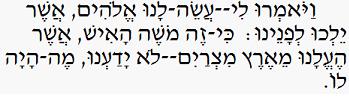
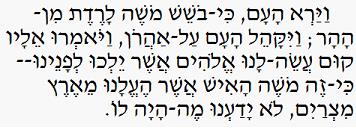
And when the people saw that Moses delayed to come down from the mount, the people gathered themselves together unto Aaron, and said unto him: ‘Up, make us a god who shall go before us; for as for this Moses, the man that brought us up out of the land of Egypt, we know not what is become of him. (Exodus 32, 1)

term3

The sin of the Golden Calf was ultimately the sin of timidity…. Which it turns out, may be the greatest possible crime a human being can commit. Timidity is an evil that every generation; every individual must protect himself from. The Midrash says: “there is no generation that doesn’t take a small portion of the sin of the Golden Calf”. (Shemot Rabba 43, 3).

The Exodus Revolution had proclaimed that you serve only one God… and therefore … and this is the punch line… you serve no object and certainly no man or power produced by man… you cannot live vicariously, not through celebrities, not through heroes … not even Moses. The Exodus Revolution’s credo was that you serve no man, no king, no priest, no angel, no messenger.. You serve only God. You cannot delegate your responsibilities and neither will God. By example, God did not delegate the revolution to Moses nor to an Angel and neither can you. As it says in the Haggadah:

“The Lord took us out of Egypt,” not through an angel, not through a seraph and not through a messenger. The Holy One, blessed be He, did it in His glory by Himself.

Thus it is said: “In that night I will pass through the land of Egypt, and I will smite every first-born in the land of Egypt, from man to beast, and I will carry out judgments against all the gods of Egypt, I the Lord.

“I will pass through the land of Egypt,” I and not an angel;

“And I will smite every first-born in the land of Egypt,” I and not a seraph;

 ”And I will carry out judgments against all the gods of Egypt,” I and not a messenger;

“I the Lord,” it is I, and none other!

Which brings us to playing it large….. I was introduced to the concept of greatness… Gadlut (Gadlus HaAdam) and its opposite; the sin of smallness Katnut  קטנות   when studying Mussar  under the guidance of HaRav Shlomo Wolbe zt”l.

“The beginning of the way of anyone who learns Mussar today needs to be: learn the elevatedness of a human. He must climb the ladder that leads to awareness of greatness.” (quoted from Alei Shur vol I)

Avrohom Eliyahu Kaplan was a 19th century thinker equally influenced by Mussar and Hasidism who I discovered in my mussar days and who writes in poetic terms in his book: Be’ikvos haYir’ah  about the false humility that is the bad place of the worshipers of the Golden Calf.:

It is not pride that holds us back, but rather humility. We are humble and not brash. Our souls are like widows, without anything to lean on or security, without the power of knowledge. A humility not in God’s name is this; rather in the name of laziness that is in despair that is in laziness. It is for the poor who are ‘happy with their portion’.. that is, in their spiritual portion.

kaplan

It is this same misplaced humility that Nelson Mandela warned against on the day of his inauguration:

Our deepest fear is not that we are inadequate. Our deepest fear is that we are powerful beyond measure. It is our light, not our darkness that most frightens us.’ We ask ourselves, Who am I to be brilliant, gorgeous, talented, fabulous? Actually, who are you not to be? You are a child of God. Your playing small does not serve the world. (click here for actual source of quote)

The Golden Calf challenges us to acknowledge that what we fear most, in our lives and in our loves, in our actions and in our relationships, is not the unknown, but what we know, not death but the untapped possibilities of life.  We fear not that which limits us but rather we fear that which is inside of us and in our relationships which has no limits.

The question we continually must ask as individuals and as societies: Do we dare to take control of our own destiny or do we leave such things for others, for others who are; comfortably for us, not quite human? In short, do we want to go back to the Egypt of the past where we were slaves, or do we move on to our promised land with the responsibility of freedom on our shoulders?  The sin of the Golden Calf (along with much else associated with precious metals and stones) is not that we want too much, but that we want too little. The sin of the Golden Calf is not of false pride but of false modesty.

Thou Shalt not play small …. neither in life nor in love!

think bigger

2 Comments

Filed under Bible, Chosen People, Judaism, Religion, social commentary

two states no apologies

parshat mishpatim

Apologetics is the bastard child of biblical interpretation and is practiced primarily under duress.  Apologetics is used, not to determine the meaning of the text but simply to defend a sacred text from detractors.  I have always belittled this approach. I prefer to disagree and if necessary negate a biblical injunction then twist it to suite my modern palate.  I believe that the Rabbis did this when they declared that “There never has been a ‘stubborn and rebellious son” [In the Biblical sense, to be executed Sanhedrin 71a] and when they virtually nullified the prohibition to take interest  ribbit (ריבית) on a loan.

But in a world where there are fundamentalists who take a text at it’s face value and give it power to affect our shared world, it becomes necessary to address even the most archaic rules and practices preserved in scripture.  And …. unless we are willing to censor the public reading of these texts in our places of worship, don’t we all have to become de facto apologists to make these texts acceptable for our children and grandchildren?

Which brings me to the subject of Israel’s biblical borders and apparent prescription for forced transfer of the resident population…. and how I  struggle with it’s meaning and question its validity.

The first mention of what could be taken as an “ethnic cleansing” provision in the Hebrew Bible is found in Parshat Mishpatim, and appears not as a command, but a Divine promise (let the apologetics commence….)

See, I am sending an angel ahead of you to guard you along the way and to bring you to the place I have prepared. Pay attention to him and listen to what he says. Do not rebel against him; he will not forgive your rebellion, since my Name is in him. If you listen carefully to what he says and do all that I say, I will be an enemy to your enemies and will oppose those who oppose you. My angel will go ahead of you and bring you into the land of the Amorites, Hittites, Perizzites, Canaanites, Hivites and Jebusites, and I will wipe them out. Do not bow down before their gods or worship them or follow their practices. You must demolish them and break their sacred stones to pieces. Worship the LORD your God, and His blessing will be on your food and water. I will take away sickness from among you, and none will miscarry or be barren in your land. I will give you a full life span. I will send my terror ahead of you and throw into confusion every nation you encounter. I will make all your enemies turn their backs and run. I will send the hornet ahead of you to drive the Hivites, Canaanites and Hittites out of your way. But I will not drive them out in a single year, because the land would become desolate and the wild animals too numerous for you. Little by little I will drive them out before you, until you have increased enough to take possession of the land.

And I will set thy border from the Red Sea even unto the sea of the Philistines, and from the wilderness unto the River; for I will deliver the inhabitants (alt. rulers) of the land into your hand; and thou shalt drive them out before thee.

וְשַׁתִּי אֶת-גְּבֻלְךָ, מִיַּם-סוּף וְעַד-יָם פְּלִשְׁתִּים, וּמִמִּדְבָּר, עַד-הַנָּהָר:  כִּי אֶתֵּן בְּיֶדְכֶם, אֵת יֹשְׁבֵי הָאָרֶץ, וְגֵרַשְׁתָּמוֹ, מִפָּנֶיךָ.

Do not make a covenant with them or with their gods.

Do not let them dwell (alt. rule) in your land, or they will cause you to sin against me, because the worship of their gods will certainly be a snare to you.

לֹא יֵשְׁבוּ בְּאַרְצְךָ, פֶּן-יַחֲטִיאוּ אֹתְךָ לִי:  כִּי תַעֲבֹד אֶת-אֱלֹהֵיהֶם, כִּי-יִהְיֶה לְךָ לְמוֹקֵשׁ     (Exodus 23: 20-33)

The emphasis, in my view, is not on extermination or forced relocation of these peoples, but on not following their ways, of not making covenants with their rulers and on the positive side of spreading the Hebrew revolution. The conflict is not with the people that inhabit the land, but with the “petty monarchy and social stratification” that block the revolution. One scholar even suggests that “live in your land” Yoshev BeArtzeha, means not those who inhabit, but rather those who “rule”. Those who sit on the throne and seat of power… the “powers that be”. (Tribes of Yahweh: A Sociology of the Religion of Liberated Israel, 1250-1050 BCE, by Norman Gottwald, pp 530-534)

So next time your in Synagogue and they return the Torah to the ark and you sing Psalm 29 remember that we are not celbrating the God sat during the flood…. but that He ruled and that He will rule forever…

The LORD sat enthroned at the flood; yea, the LORD sitteth as King for ever. Psalms 29:10

יְהוָה, לַמַּבּוּל יָשָׁב;    וַיֵּשֶׁב יְהוָה, מֶלֶךְ לְעוֹלָם.

And next time you hear someone claim that there is a biblical injunction to relocate inhabitants (yoshvei ha’aretz) in the Land of Israel suggest that the verse is referring to relocating autocratic rulers, not populations. (cf. Deuteronomy 7:24 where “kings into your hand” malkehem beyadeka is used in place of yoshvei ha’aretz) *

Ultimately, the Hebrew rebellion/revolution in Canaan is only a partial success; neither God nor the Hebrew nation overcome the resident cults and petty politics. Throughout the period of the Judges and Old Testament Prophets, the recurring problem is not of limited land conquest and failure to achieve racial purity, but of a failed rebellion against the mores and practices of the pagan religions and existing social structure. Just as the Hebrews compromise and ask Samuel for a an autocratic King; such as all the other nations have, so too, they continue to assimilate the pagan practices and social stratification of the indigenous culture. Yehezkel Kaufman points out that by the end of Joshua’s life (Joshua13:1-6) “a new conception makes its appearance: “the remaining country”… a region that does not exist in the Land of Canaan of the Pentateuch.

So the LORD left those nations, without driving them out hastily; neither delivered He them into the hand of Joshua. Now these are the nations which the LORD left, to prove [test] Israel by them, even as many as had not known all the wars of Canaan; (Joshua 2:23 – 3:1)

וַיַּנַּח יְהוָה אֶת-הַגּוֹיִם הָאֵלֶּה, לְבִלְתִּי הוֹרִישָׁם מַהֵר; וְלֹא נְתָנָם, בְּיַד-יְהוֹשֻׁעַ

וְאֵלֶּה הַגּוֹיִם אֲשֶׁר הִנִּיחַ יְהוָה, לְנַסּוֹת בָּם אֶת-יִשְׂרָאֵל, אֵת כָּל-אֲשֶׁר לֹא-יָדְעוּ, אֵת כָּל-מִלְחֲמוֹת כְּנָעַן

In “the remaining country” a new people is settled: the later Philistines…. Josh 23 contains the first mention of the conception of “the remaining peoples”. Here we meet, for the first time, the warning that, if the Israelites enter into relations with these remaining peoples, Jahweh will no longer (fulfill his promise to) expel them. By the time of the judges (Judges 2:11 – 3:6) the hope of completing the Conquest is entirely abandoned.” (The Biblical Account of the Conquest of Canaan, Yehezkel Kaufman, Magnes Press, Hebrew University 1953 pp 92-93 in chapter entitled “The Problem of the Complete Conquest”)

If we look back at the original Exodus 23 texts, we can’t help but notice the hesitation.  At the time the text was written it is already clear that the roll-out did not go well and that a racially pure Greater Israel would (possibly, should) never be accomplished.  As Kaufman writes, a Greater Israel would always be more ideal than real.  Maybe the biblical order is placating a group of settlers who want it all.  The text suggests patience and possibly hope that they will grow accustomed to what is achievable and ultimately desirable… “But I will not drive them out in a single year, because the land would become desolate and the wild animals too numerous for you. Little by little I will drive them out before you…” (for conquest-by- slow stages motif cf. Deuteronomy 7:22).  At the end of the day, Greater Israel is a promise, not a command… and in Joshua, the promise morphs into a test, for which like the SAT, a perfect score is unattainable.

Let’s keep in mind that for all the rantings of the prophets against the children of Israel not achieving their goals, never are they criticized for not clearing the land of aliens. Never is the fall of the first and second Jewish Commonwealth blamed on  a failure to expand the territory.  The ultimate failure of the state is always blamed on how the Jews acted among themselves and within their borders, not for not expanding those borders.

Fast-forward to Maimonides’ code where the promise and law against the Seven Nations has become mute “Their memory has long since perished.” (Hilkhot Melakhim 5:4) As Maimonides writes: “War, whether a war of choice (milchemet hareshut) or a war of mitzvah, should not be waged against anybody until he is offered the opportunity of peace as [Deuteronomy 20:10] states: “when you approach a city to wage war against it, you must propose a peaceful settlement.” (Hilkhot Melakhim 6:1)

My read of the Torah is clear… The struggle to conquer and defeat the indigenous population in the Promised Land was always an ideological and political struggle.  This struggle of cultures is the stuff that constitutes the majority of the rantings of the Hebrew Prophets.  It was the loss of this cultural struggle between The God of Israel and the local idolatry that is blamed for the ultimate destruction.  Any physical warfare in the conquest of the land is with the (yshvei HaAretz) rulers.  The ultimate takeaway is that we need to make peace so that we can focus on our own growth and culture.  This is the ultimate test give peace a chance and acknowledge that there is strong Biblical and historical precedent for a “remaining country” and a “remaining people”… otherwise known as a two state solution.

* As Gottwald writes: “If yashav is understood as “rule”  in these contexts, the heavy emphasis on avoidance of ties with the Canaanites takes on a predominantly political, rather than ethnic, cast. Even the animus against Canaanite gods becomes an animus against the gods of the Canaanite rulers who stand in systematic oppostion to Yahweh, the God of the egalitarian Israelite.” ibid page 532

** see also:

וַיַּרְא֙ חֹתֵ֣ן מֹשֶׁ֔ה אֵ֛ת כׇּל־אֲשֶׁר־ה֥וּא עֹשֶׂ֖ה לָעָ֑ם וַיֹּ֗אמֶר מָֽה־הַדָּבָ֤ר הַזֶּה֙ אֲשֶׁ֨ר אַתָּ֤ה עֹשֶׂה֙ לָעָ֔ם מַדּ֗וּעַ אַתָּ֤ה יוֹשֵׁב֙ לְבַדֶּ֔ךָ וְכׇל־הָעָ֛ם נִצָּ֥ב עָלֶ֖יךָ מִן־בֹּ֥קֶר עַד־עָֽרֶב׃
But when Moses’ father-in-law saw how much he had to do for the people, he said, “What is this thing that you are doing to the people? Why do you act *Lit. “sit” as magistrate; cf. v. 13. alone, while all the people stand about you from morning until evening?”
Two-State Solution by MIKE LUCKOVICH

Two-State Solution by MIKE LUCKOVICH

Leave a comment

Filed under Bible, Chosen People, Hebrew, Israel, Judaism, Palestinians, Religion, social commentary, Torah, Uncategorized

bullish on intellectual property values

parshat yitro

Any student of the oral tradition (Mishna, Talmud, Midrashic literature) knows the lengths to which our scholars go to correctly identify their sources.

The Talmud even argues that offering one’s source can bring ultimate salvation. From Pirkei Avot (6:6; cf Hullin 104b, etc): kol ha’omer davar b’shem omro, mevi geula l’olam – whoever says something in the name of the one who said it [first], brings redemption to the world (or, gains eternal life). Why redemption, for properly attributing source material? The Talmud (Megillah 15) cites Esther 2:22 – “Queen Esther told the King in the name of Mordecai” of the plot against him. This extraneous positive mention later surfaced, leading the King to put Mordecai above Haman, leading to the redemption of Shushan’s Jews.

This concept of honoring and revealing one’s sources goes back to the Bible. One cannot but take notice that when the Bible segues between the narrative introduction of Genesis and the first chapters of Exodus (creation, the patriarchs and the exodus from Egypt), and enters the real business of providing a legal code, it abruptly introduces Jethro; Moses’ father in law, a local pagan minister and tribal leader.

Jethro is credited with providing a hierarchy and organizational tree for the Judicial Branch. In fact, a whole section of the weekly torah readings is named after Jethro. This same weekly portion contains the Ten Commandments but it is Jethro who gets top billing. Read the text:

And Jethro, the priest of Midian, Moses’ father-in-law, heard of all that God had done for Moses and for Israel His people; that the Lord had brought Israel out of Egypt.” ….. And Jethro said, “Blessed be the Lord, who has delivered you out of the hand of the Egyptians and out of the hand of Pharaoh, and who has delivered the people from under the hand of the Egyptians.…Then Jethro, Moses’ father-in-law, took a burnt offering and other sacrifices to offer to God.”.…. And so it was, on the next day, that Moses sat to judge the people; and the people stood before Moses from morning until evening. So when Moses’ father-in-law saw all that he did for the people, he said, “What is this thing that you are doing for the people? Why do you alone sit, and all the people stand before you from morning until evening?” …. “The thing that you do is not good. ( לֹא-טוֹב cf Genesis 2:18) Both you and these people who are with you will surely wear yourselves out. For this thing is too much for you; you are not able to perform it by yourself. Listen now to my voice; I will give you counsel, and God will be with you: …. you shall select from all the people able men, such as fear God, men of truth, hating covetousness; and place such over them to be rulers of thousands, rulers of hundreds, rulers of fifties, and rulers of tens. And let them judge the people at all times. Then it will be that every great matter they shall bring to you, but every small matter they themselves shall judge. So it will be easier for you, for they will bear the burden with you. If you do this thing, and God so commands you, then you will be able to endure, and all this people will also go to their place in peace. Exodus 18 1 – 23

At least as regards the structure of the Judiciary Branch, the Torah does not suffer from a Not Invented Here mentality and for that it distinguishes itself from many ideologies and ideologues… But a careful reading of the text reveals that Jethro is used to introduce more than just a pre-existent or pagan system of courts incorporated into the Divine Law. Note that Jethro also “took a burnt offering and other sacrifices to offer to God”. As the Etz Hayim commentary correctly notes: “These are the two main types of sacrifices offered in ancient Israel. The first, olah, was wholly consumed by fire on the alter as a tribute to God; the second, zevah, was partially offered up, and the major portion eaten at a festive meal.” So the Torah, in suggesting that much of the laws to follow were “borrowed” from the existing culture and religion of the day, does not limit itself to Judiciary reform… it includes also the ritual law, including the sacrosanct priestly code of the temple and it’s sacrifices.

In a previous post we detailed how Maimonides channeled the pagan antecedence of  Biblical ritual and religious practice.  Today, I am in LA, land of Beverly Hills and it’s Beverly Hillbillies and thinking how Jethro and his family (in the sitcom that is) were to be a foil, mirror and ultimate source of inspiration (nay, salvation) for their neighbors.  ~

Ultimately, admitting our sources is our salvation and denouncing our sources is the beginning of “orthodoxy”,decay and ultimate petrification.  Daniel Boyarin, in a wonderful book called Border Lines tries to show how both Rabbinic Judaism and Christianity invented Orthodox Religion to separate their practice and beliefs from each other and from their past.  It’s a fascinating book but  what relates to our discussion is his observation that “what counts as heresy… is often the traditional religion of a generation before. (p59)

Boyarin quotes the first Mishna in the tenth chapter of the tractate of Sanhedrin: “These are they that have no place in the next world: One who denies the resurrection of the dead, one who denies the [Oral] Torah is from heaven.. Boyarin points out that “Resurrection and the revealed Oral Law are the major doctrinal points of issue  between the Pharisees and the Sadducees”  The Pharisees are the precursors of Rabbinic (Orthodox) Judaism who wrote the Mishna and wrote out pre-existing groups and belief systems such as held by the Sadducees.  The other group the Rabbis meant to delegitimize were (my favorite) .. the Am Haaretz “People of the Land” who likewise had no use for the Oral Torah discovered by the Jews returning from Babylonia.

Boyarin quotes scholar Shemaryahu Talmon of the Am Haaretz: “These groups are arguably descended from the people who had not gone into exile in Babylonia: “Those who had been permitted by the babylonians to remain in the land in essence did not change their life style, economic structure, and religious-cultic customs, notwithstanding the loss of political sovereignity and cultic institutions and the incurrance of economic hardship.  They were the conservatives who clung to their established systems of values, despite the changed circumstances” ( footnote 122, page 251)

It seems to me that the salvation that comes from giving value to our joint, and many times inconvenient and muddled cultural intellectual property is to help save us from ourselves.  In denying the many times primitive, but sometimes pure and simple ideas of our predecessors, we risk suffocating our options, alternative opinions and natural creativity in an orthodoxy that claims to reflect a past that never existed…

———————

Jethro Bodine of the Beverly Hillbillies

Jethro Bodine of the Beverly Hillbillies

~ I’m actually in Santa Monica but Hanuka came early this year so I can’t incorporate Tom Lehrer’s “Hanuka in Santa Monica” into the post .. but if you haven’t heard it click the  link…


Leave a comment

Filed under Bible, Chosen People, Judaism, Religion, social commentary, Torah

the children of Israel are perplexed… God bless them

parshat beshalach

The Hebrew word for Perplexed – Nevuchim, first appears in the Torah in the mouth of Pharaoh… Exodus 14:3 who sees that the Jews look confused and perplexed… and are living up to their latter appellation of Wandering Jews…

And Pharaoh will say of the children of Israel: They are perplexed in the land, the wilderness hath shut them in.

וְאָמַר פַּרְעֹה לִבְנֵי יִשְׂרָאֵל, נְבֻכִים הֵם בָּאָרֶץ; סָגַר עֲלֵיהֶם, הַמִּדְבָּר.

Buried in Part III, chapter 32 of The Guide for the Perplexed (Moreh Nevuchim), Maimonides makes a radical suggestion (quoted in full in the footnote[ii]); namely that all the laws of the Temple and Priesthood are only borrowed conventions, designed to move his Chosen People and humanity in a new direction. Maimonides calls this a “gracious ruse” a concept perhaps borrowed from the second-century-C.E. philosopher Alexander of Aphrodisias who developed the theory of divine condescendence (Greek synkatabasis; cf. Arabic talattuf)[iii] where God, in His Torah, not only “speaks in the language of man” but also legislates using existing social norms and customs, as limited as they may be. Similar to the Lurianic Kabbalistic concept of contraction (Tzimzum), God and His Torah, so to speak, descends into the muck of the crooked timber of humanity to enrich the human condition.

Even rituals such as fasting, tzizit, mezuzah, tefillin, supplications, prayers and similar kinds of worship… even the festivals and the Shabbat, are not the goal… but means to a goal and were ultimately poached, absorbed or modified from existing pagan practices. According to Maimonides, it is our job, 2,000 plus years later to try to discern the direction to which these intermediary steps are pointing. It is our job, nay mitzvah, to study comparative religion of the ancient Near East and to try to distinguish what parts of the teachings and commandments of the Torah are “borrowed” steps and which contain within them ultimate goals.

Maimonides realized the radical nature of such a suggestion.  He writes:

I know that you will at first thought reject this idea and find it strange: you will put the following question to me in your heart: How can we suppose that Divine commandments, prohibitions, and important acts, which are fully explained, and for which certain seasons are fixed, should not have been commanded for their own sake, but only for the sake of some other thing: as if they were only the means which He employed for His primary object? ….. Hear my answer, which will cure your heart of this disease and will show you the truth of that which I have pointed out to you. There occurs in the Law a passage which contains exactly the same idea; it is the following:” God led them not through the way of the land of the Philistines, although that was near; for God said, Lest peradventure the people repent when they see war, and they return to Egypt; but God led the people about, through the way of the wilderness of the Red Sea,” etc. (Exod. xiii. 17). Here God led the people about, away from the direct road which He originally intended, because He feared they might meet on that way with hardships too great for their ordinary strength; He took them by another road in order to obtain thereby His original object. In the same manner God refrained from prescribing what the people by their natural disposition would be incapable of obeying, and gave the above-mentioned commandments as a means of securing His chief object, viz., to spread a knowledge of Him [among the people], and to cause them to reject idolatry.

This is truly a paradigm shift for our task in studying the Torah is now turned on its head.  Not only are we implicitly obligated to use comparative religion, anthropology, archaeology, Near Eastern studies, linguistics, sociology and common sense to understand the context and antecedents of Biblical law and narrative, but we are challenged to discern not the letter of the law but rather the direction in which it points.  Torah is less a book of laws and more a path… an arguably crooked and perplexing path.. but one we are dared to follow.    

Happy are they that are upright in the way, who walk in the torah of the LORD.  (Psalms 119: 1)

אַשְׁרֵי תְמִימֵי-דָרֶךְ–    הַהֹלְכִים, בְּתוֹרַת יְהוָה


[ii] It is, namely, impossible to go suddenly from one extreme to the other: it is therefore according to the nature of man impossible for him suddenly to discontinue everything to which he has been accustomed. Now God sent Moses to make [the Israelites] a kingdom of priests and a holy nation (Exod. xix. 6) by means of the knowledge of God. …. But the custom which was in those days general among all men, and the general mode of worship in which the Israelites were brought up, consisted in sacrificing animals in those temples which contained certain images, to bow down to those images, and to burn incense before them; religious and ascetic persons were in those days the persons that were devoted to the service in the temples erected to the stars,  It was in accordance with the wisdom and plan of God (literally “gracious ruse”), as displayed in the whole Creation, that He did not command us to give up and to discontinue all these manners of service; for to obey such a commandment it would have been contrary to the nature of man, who generally cleaves to that to which he is used; it would in those days have made the same impression as a prophet would make at present if he called us to the service of God and told us in His name, that we should not pray to Him, not fast, not seek His help in time of trouble; that we should serve Him in thought, and not by any action. For this reason God allowed these kinds of service to continue; He transferred to His service that which had formerly served as a worship of created beings, and of things imaginary and unreal, and commanded us to serve Him in the same manner; viz., to build unto Him a temple; … He selected priests for the service in the temple; …He made it obligatory that certain gifts, called the gifts of the Levites and the priests, should be assigned to them for their maintenance while they are engaged in the service of the temple and its sacrifices. By this Divine plan (literally “gracious ruse”) it was effected that the traces of idolatry were blotted out, and the truly great principle of our faith, the Existence and Unity of God, was firmly established; this result was thus obtained without deterring or confusing the minds of the people by the abolition of the service to which they were accustomed and which alone was familiar to them.

I know that you will at first thought reject this idea and find it strange: you will put the following question to me in your heart: How can we suppose that Divine commandments, prohibitions, and important acts, which are fully explained, and for which certain seasons are fixed, should not have been commanded for their own sake, but only for the sake of some other thing: as if they were only the means which He employed for His primary object? ….. Hear my answer, which will cure your heart of this disease and will show you the truth of that which I have pointed out to you. There occurs in the Law a passage which contains exactly the same idea; it is the following:” God led them not through the way of the land of the Philistines, although that was near; for God said, Lest peradventure the people repent when they see war, and they return to Egypt; but God led the people about, through the way of the wilderness of the Red Sea,” etc. (Exod. xiii. 17). Here God led the people about, away from the direct road which He originally intended, because He feared they might meet on that way with hardships too great for their ordinary strength; He took them by another road in order to obtain thereby His original object. In the same manner God refrained from prescribing what the people by their natural disposition would be incapable of obeying, and gave the above-mentioned commandments as a means of securing His chief object, viz., to spread a knowledge of Him [among the people], and to cause them to reject idolatry. It is contrary to man’s nature that he should suddenly abandon all the different kinds of Divine service and the different customs in which he has been brought up, and which have been so general, that they were considered as a matter of course; …In the same way the portion of the Law under discussion is the result of divine wisdom (literally “gracious ruse”), according to which people are allowed to continue the kind of worship to which they have been accustomed, in order that they might acquire the true faith, which is the chief object [of God’s commandments]. …As the sacrificial service is not the primary object [of the commandments about sacrifice], whilst supplications, Prayers and similar kinds of worship are nearer to the primary object, and indispensable for obtaining it, a great difference was made in the Law between these two kinds of service. The one kind, which consists in offering sacrifices, although the sacrifices are offered to the name of God, has not been made obligatory for us to the same extent as it had been before. We were not commanded to sacrifice in every place, and in every time, or to build a temple in every place, or to permit anyone who desires to become priest and to sacrifice. On the contrary, all this is prohibited unto us. Only one temple has been appointed,” in the place which the Lord shall choose” (Deut. xii. 26): in no other place is it allowed to sacrifice: …. and only the members of a particular family were allowed to officiate as priests. All these restrictions served to limit this kind of worship, and keep it within those bounds within which God did not think it necessary to abolish sacrificial service altogether. But prayer and supplication can be offered everywhere and by every person. The same is the case with the commandment of zizit (Num. xy. 38); mezuzah (Dent. vi. 9; xi. 20); tefillin (Exod. xiii. 9, 16): and similar kinds of divine service.

Because of this principle which I explained to you, the Prophets in their books are frequently found to rebuke their fellow-men for being over-zealous and exerting themselves too much in bringing sacrifices: the prophets thus distinctly declared that the object of the sacrifices is not very essential, and that God does not require them. …. Isaiah exclaimed,” To what purpose is the multitude of your sacrifices unto me? saith the Lord” (Isa. i. 11): ….For it is distinctly stated in Scripture, and handed down by tradition, that the first commandments communicated to us did not include any law at all about burnt-offering and sacrifice. ….. …. The Psalmist says:” Hear, 0 my people, and I will speak; 0 Israel, and I will testify against thee: I am God, even thy God. I will not reprove thee for thy sacrifices or thy burnt-offerings, they have been continually before me. I will take no bullock out of thy house, nor he-goats out of thy folds” (Ps. 1. 29).– Wherever this subject is mentioned, this is its meaning. Consider it well, and reflect on it.

[iii] See A New Science: The Discovery of Religion in the Age of Reason By Guy G. Stroumsa Harvard University Press, 2010 page 93

For a source of Temple as gracious ruse in the Midrash, see:

מדרש אגדה תרומה:

“דבר אל בני ישראל ויקחו לי תרומה … ועשית את המזבח עצי שטים” – כל עניין המנורה והשולחן והמזבח והקרשים והאהל והיריעות וכל כלי המשכן – מפני מה? אמרו ישראל לפני הקב”ה: ריבונו של עולם, מלכי הגויים יש להם אוהל ושולחן ומנורה ומקטר קטורת, וכן הוא תכסיסי מלוכה, כי כל מלך צריך לכך, ואתה הוא מלכנו גואלנו מושיענו – לא יהיו לפניך תכסיסי מלוכה, עד שיוודע לכל באי עולם כי אתה הוא המלך?

אמר להם: בני, אותם בשר ודם צריכים לכל זה, אבל אני איני צריך, כי אין לפני לא אכילה ולא שתייה, ואיני צריך מאור, ועבדי יוכיחו כי השמש והירח מאירים לכל העולם ואני משפיע עליהם מאורי, ואני אשגיח עליכם לטובה בזכות אבותיכם.

אמרו ישראל לפני הקב”ה: ריבונו של עולם, אין אנחנו מבקשים את האבות (ישעיה ס”ג), “כי אתה אבינו, אברהם לא ידענו וישראל לא הכרנו”. אמר להם הקב”ה: אם כן, עשו מה שאתם חפצים, אלא עשו אותם כאשר אני מצווה אתכם… שנאמר “ועשו לי מקדש…” “ועשו מנורה… ועשו שולחן… ועשו מזבח מקטר קטרת”.

1 Comment

Filed under Bible, Chosen People, Hebrew, Israel, Judaism, Pilgrimage, social commentary, Torah

the hiker’s guide to zionism

Parshat Vayishlach [i]

Genesis could be read as the recurring tale of exile and return.  Adam and Eve are exiled from Eden, Cain is marked as a wonderer on the earth and the flood removes Noah from the face of the earth and famine causes the temporary migration of both Abraham and Isaac.  Sin is usually associated with, or the cause of exile.  In the case of Adam and Eve and Cain, the sin is Original Sin or fratricide, respectively. In the case of Noah, the sin is of humankind, and in the case of Abraham and Isaac, it is exile itself that makes them into liars as they both claim their wives are their sisters.

If the purpose of a grim fairy tale is to help the reader master a difficult subject, then the repetition of the exile and return motif may be designed to help the reader internalize a core component of the Jewish pathos.

It is with Jacob that the return to the homeland takes gets some meat on its bones.  Maybe because Jacob is exiled as a child, without a wife, without a profession and without any possessions, when he returns with all of the above, it is a true return from exile.  In any case, one could argue that Jacob was the first Zionist.

Zionism as a 19th century movement, was not simply a migration ideology or even as some of it’s critics would argue, a movement of physical or cultural imperialism.  Rather, Zionism, at it’s core, was a 19th century articulation of an earlier Jewish (Hebraic) belief that Judaism could be practiced only in the historical land of Israel and by extension, that Jews (Hebrews) could only be themselves (normal) in the land of Israel.

This view did not emerge in the 19th century, it actually lies at the heart of the word Zion.

Deuteronomy 11, 18 (the 2nd paragraph of the Shma prayer recited twice a day and containd in both the tephilin and the mezuzah):

And you shall set these words of Mine upon your heart and upon your soul, and bind them for a sign upon your hand and they shall be for ornaments between your eyes.

 וְשַׂמְתֶּם אֶת דְּבָרַי אֵלֶּה עַל לְבַבְכֶם וְעַל נַפְשְׁכֶם וּקְשַׁרְתֶּם אֹתָם לְאוֹת עַל יֶדְכֶם וְהָיוּ לְטוֹטָפֹת בֵּין עֵינֵיכֶם:

Rashi:    And you shall set these words of Mine: Even after you have been exiled, make yourselves distinctive with My commandments: Put on tefillin and make mezuzoth , so that these will not be new to you when you return. Similarly, it is said, “Set up markers for yourself” (Jer. 31:20). – [Sifrei]

ושמתם את דברי: אף לאחר שתגלו היו מצויינים במצות, הניחו תפילין, עשו מזוזות כדי שלא יהיו לכם חדשים כשתחזרו. וכן הוא אומר (ירמיה לא, כ) הציבי לך ציונים:

There have always been a category of the commandments which are only practiced in the land of Israel (מצוות התלויות בארץ), but Rashi (based on the Sifrei Deuteronomy 43) is saying something much more radical here…. Namely, that Judaism can only be practiced in the land of Israel!

This is also the position of the Ramban which is that the fulfillment of even personal obligations in the Diaspora is meant to serve as training for fulfilling those same mitzvot in Israel; rituals, rites and commandments fulfilled in exile serve as signposts, leading the way back to living in the Land of Israel according to the Torah.  Rabbeinu Bachya similarly holds with regard to all mitzvot for which the essential obligation is in Israel, “These are the statutes and judgments which you shall observe to do in the land” (Devarim 12:1) — for all the mitzvot are the judgments of the God of the land.

It is interesting that none of the commentaries note the play on words of Zion and signposts… markers.

The word Tzion[ii] is usually taken to mean a sunny or parched place… another name for Jerusalem especially in the prophetic books… but as Rashi notes, it can also mean a signpost, monument, market[iii]… some have suggested: migration paths…

Only fro mthis perspective are statements in the Talmud such as:

Whoever lives in the Land of Israel may be considered to have a God, but whoever lives outside the Land may be regarded as one who has no God. For it is said in Scripture, ‘To give you the Land of Canaan, to be your God’ (Leviticus 25:38). Has he, then, who does not live in the Land, no God? But [this is what the text intended] to tell you, that whoever lives outside the Land may be regarded as one who worships idols. Similarly it was said in Scripture in [the story of] David, ‘For they have driven me out this day that I should not cleave to the inheritance of the Lord, saying: Go, serve other gods’ (First Samuel 26:19). Now, whoever said to David, ‘Serve other gods’? Rather, [the text intends] to tell you that whoever lives outside the Land may be regarded as one who worships idols” (Ketubot 110b)

Clearly there are other religions and cultures that have holy sites at which special rituals need be fulfilled.  Think of Mecca for the Hajj.  The Parsis in India who consider certain geographical locations critical to rights such as burial, do not accept converts and have a healthy diaspora.

One can certainly imagine the original Zionism as the belief of a migrating tribe in the holiness of the land of Canaan, where rituals practiced outside of the land were only previews and rehearsals and were the real show opens and runs only in the Holy Land.

Jewish thinkers, leaders and masses carried these notions through two thousand years of diaspora and nineteenth century secular Zionist thinker simply adopted this primal concept into a modern, but unique ideological movement.  Zionism was neither imperialism nor racism.

For those of us who live outside of the land of Israel and consider ourselves Zionists it is humbling to know that Zionism (and Judaism) is not an ideology but rather a zip code but it is also radically exciting.  Location specific Judaism confirms what we feel as we drive around this country and meet Israelis of every variation.  It is confirmed when we take a hike on the clearly marked Israel trail with a secular Israeli pointing out ancient aqueducts, iconic kibbutzim and modern day borders…and without a hidden agenda or political lesson to be learnt. This is truly the holy land and one of the best ways to feel it, breath it and experience it is to follow the markers and take a hike.

israel trail


[i] For a previous Madlik post on parshat vayishlach, see appeasement first.

[ii] Strong’s H6726 – Tsiyown

Tzion-1

[iii] Strong’s H6725 – tsiyuwn

Tzion-2

Leave a comment

Filed under Bible, Chosen People, Hebrew, Israel, Judaism, magic, Pilgrimage, Religion, social commentary, Torah, travel

kosher sex and jacob’s heel

parshat toldot

“Reading the Bible in translation is like kissing your new bride through a veil.” famously quipped Haim Nachman Bialik.

I would love to see this quote as Bialik as published or documented verbatim and in the original Hebrew. I’m suspicious that what I find attributed to Bialik as it may just be a translation or paraphrase:

תרגום דומה לנשיקה מבעד לצעיף

I’m sure that reading Bialik in translation is a similarly less-than sensual experience.  Did he say bride or girl, did he mean just a kiss or was he suggesting something more intimate and finally was it a veil or the proverbial sheet?  In any case, I do agree with Bialik that learning Torah can be like sex and in this regard it should not be practiced safely with an interfering translation… it should be done … in the original Hebrew.

While we’re on the subject of kosher sex, let’s consider one of the best examples of lost-in-translation in the Bible.

Genesis 26 sets the stage wherein Isaac fibs about his wife and tells Abimelech that Rebecca is his sister.

8 And it came to pass, when he had been there a long time, that Abimelech king of the Philistines looked out at a window, and saw, and, behold, Isaac was sporting with Rebekah his wife.

וַיְהִי, כִּי אָרְכוּ-לוֹ שָׁם הַיָּמִים, וַיַּשְׁקֵף אֲבִימֶלֶךְ מֶלֶךְ פְּלִשְׁתִּים, בְּעַד הַחַלּוֹן; וַיַּרְא, וְהִנֵּה יִצְחָק מְצַחֵק, אֵת, רִבְקָה אִשְׁתּוֹ.

The Hebrew word that the text uses for “sporting” is metzahek which comes from the same Hebrew root as does Isaac’s name: listen: “Yitzhak metzahek”.  It is clear that the biblical writer, along with Isaac, was having some fun here. This is the only place[i] in the Bible that metzahek is used to imply sexual activity…. Unless, of course, we now re-read the texts associated with the original association of Yitzhak’s name with the laughter of Sarah and Abraham ….. and realize that his parents laughed at the thought of procreating a child…. (see Gen 17:17, 18:12,13 and 15 and 21:6).  So maybe Yitzchak’s “sporting” makes us realize that there was always sexual innuendo in the glee, gaiety, and amazement with a-touch-of-self-mockery that his parents, he and maybe we feel at the joy of sex. Hey.. It’s not me… it’s the Hebrew talking.

The modern day scholar who focuses most closely on the original Hebrew sounds of the biblical text is Everett Fox, who has written a translation of the Torah following on the heels of Martin Buber and Franz Rosenzweig.  Fox takes the Bible, if not as an oral document, certainly as an aural one.  Fox believes that using echoes, allusions, and powerful inner structures of sound, the text of the Bible is often able to convey ideas in a manner that vocabulary alone cannot do.  Fox argues that virtually every major (usually male) character in Genesis has his name explained by a play on words many time hinting at an eventual fate or character trait.

Let’s listen to the story of Jacob in Genesis 25:26

26 And after that came forth his brother, and his hand had hold on Esau’s heel; and his name was called Jacob. And Isaac was threescore years old when she bore them.

וְאַחֲרֵי-כֵן יָצָא אָחִיו, וְיָדוֹ אֹחֶזֶת בַּעֲקֵב עֵשָׂו, וַיִּקְרָא שְׁמוֹ, יַעֲקֹב; וְיִצְחָק בֶּן-שִׁשִּׁים שָׁנָה, בְּלֶדֶת אֹתָם

The association of Jacob – Yaakov with a heel is strange.  Jacob is not the only mythical hero with a famous heel, but in Achilles case, he was the owner of the heel.  Jacob’s relationship with his brother’s heel is vicarious.  If the biblical author, let alone his parents, want to be flattering, they do a lousy job.   Jacob is to be known, at best, as a “hanger on”. Fox’s translation: “Heel-Holder”

Even if we choose to think of Jacob as a bootstrapper, we can’t forget that he pulls himself up by a bootstrap attached to his brothers heal.  And let’s not forget that Esau’s heal, like Achilles, is his most vulnerable body part. Metaphorically, the heel[ii] is the exposed rear of an army (see Joshua 8:13 and Genesis 49:19).  When God curses the snake for tempting Eve, it is on the snake’s metaphorical heel that man shall forever stamp (Genesis 3:15).  Attacking an enemy’s heel is an insult to both the attacker and the victim.

Our unflattering association is echoed by Esau himself latter in the story.  After Jacob steals the birthright, Esau taunts (Genesis 27:36):

And he said: ‘Is not he rightly named Jacob? for he hath supplanted me these two times: he took away my birthright; and, behold, now he hath taken away my blessing.’ And he said: ‘Hast thou not reserved a blessing for me?’

וַיֹּאמֶר הֲכִי קָרָא שְׁמוֹ יַעֲקֹב, וַיַּעְקְבֵנִי זֶה פַעֲמַיִם–אֶת-בְּכֹרָתִי לָקָח, וְהִנֵּה עַתָּה לָקַח בִּרְכָתִי; וַיֹּאמַר, הֲלֹא-אָצַלְתָּ לִּי בְּרָכָה.

Here Ekev-heel is used in the sense of “to throw one down, to trip one up, to supplant, to circumvent, to defraud.[iii]  Fox’s translation: “Heel-Sneak”. Check out Jeremiah 9:3

Take ye heed every one of his neighbour, and trust ye not in any brother; for every brother acteth subtly, and every neighbour goeth about with slanders.

אִישׁ מֵרֵעֵהוּ הִשָּׁמֵרוּ, וְעַל-כָּל-אָח אַל-תִּבְטָחוּ:  כִּי כָל-אָח עָקוֹב יַעְקֹב, וְכָל-רֵעַ רָכִיל יַהֲלֹךְ

Jeremiah is pulling no punches, he uses “ekov Yaakov” the “heel of Jacob” as a synonym for acting subtly.

What kind of parents would the biblical author have Isaac and Rebecca be?  Who gives a child such a name?

Clearly, Jacob is in need of a name change… and in fact, this is what happens after he wrestles with the Angel at the River Jabbok (literally: wrestling river).

There is nothing flattering that one can say about Yaakov’s name.  His name can only portend a change.  A change from a swindler, a scrapper, a kniver… someone who by choice or circumstance is forced to steal his blessings and eke out a living and a life.  Yaakov is the outsider, the Ghetto Jew, but his name portends another name, where he crosses the river into his homeland and can stand on his own feet and pull himself up from his own bootstraps … attached to his own heel.  This is what hopefully lies ahead for him in his future name and this is what presumably is up for grabs in the blessing that he steals.

So far in the text, you don’t have to listen to the Hebrew words of the text, you can look the words up in a dictionary or Biblical Lexicon… but when it comes to the patrimony and blessing that Jacob coveted… you have to listen: (Genesis 26: 3-5)

3 Sojourn in this land, and I will be with thee, and will bless thee; for unto thee, and unto thy seed, I will give all these lands, and I will establish the oath which I swore unto Abraham thy father;

4 and I will multiply thy seed as the stars of heaven, and will give unto thy seed all these lands; and by thy seed shall all the nations of the earth bless themselves;

5 because that Abraham hearkened to My voice, and kept My charge, My commandments, My statutes, and My laws.’

גּוּר בָּאָרֶץ הַזֹּאת, וְאֶהְיֶה עִמְּךָ וַאֲבָרְכֶךָּ:  כִּי-לְךָ וּלְזַרְעֲךָ, אֶתֵּן אֶת-כָּל-הָאֲרָצֹת הָאֵל, וַהֲקִמֹתִי אֶת-הַשְּׁבֻעָה, אֲשֶׁר נִשְׁבַּעְתִּי לְאַבְרָהָם אָבִיךָ.

וְהִרְבֵּיתִי אֶת-זַרְעֲךָ, כְּכוֹכְבֵי הַשָּׁמַיִם, וְנָתַתִּי לְזַרְעֲךָ, אֵת כָּל-הָאֲרָצֹת הָאֵל; וְהִתְבָּרְכוּ בְזַרְעֲךָ, כֹּל גּוֹיֵי הָאָרֶץ.

עֵקֶב, אֲשֶׁר-שָׁמַע אַבְרָהָם בְּקֹלִי; וַיִּשְׁמֹר, מִשְׁמַרְתִּי, מִצְו‍ֹתַי, חֻקּוֹתַי וְתוֹרֹתָי.

The word translated as “because” is our old friend “ekev”[iv]. Used in this fairly rare sense, it has the sense of “as a consequence, a gain, a reward, end”.  It is that which results from a long, tedious, painful, tortuous and circuitous journey. A pilgrimage full of blisters and maybe a touch of plantar fasciitis.  Esau, might have been, like Achilles, the golden boy and favorite son and Yaakov, the parasite, but Yaakov struggled with what little he had.  Esau may have been well heeled, but Yaakov had the fortitude and faith in a God of history to grab steadfastly for a better future[v].  He deserved the blessing… it had his name on it.

Listening to the lyricism of the words in the original Hebrew and opening our ears to the playful and suggestive way the writer weaves one word; ekev into the narrative, we can do what Fox[vi] suggests we do; move explanation and commentary from the footnotes, back to the body of the text and in so doing.. we can finally… kiss the bride.


[i] See Strongs Biblical lexicon tsachaq H6711

Lexicon :: Strong's H6711 - tsachaq

Lexicon :: Strong’s H6711 – tsachaq


[ii] See Strongs Biblical lexicon aqeb H6119

Lexicon :: Strong's H6119 - `aqeb

Lexicon :: Strong’s H6119 – `aqeb


[iii] See Stongs Biblical Lexicon aqab  H6117

Lexicon :: Strong's H6117 - `aqab

Lexicon :: Strong’s H6117 – `aqab


[iv] See Strongs Biblical Lexicon 86118

Lexicon :: Strong's H6118 - `eqeb

Lexicon :: Strong’s H6118 – `eqeb


[v] It is no surprise that this last sense of Ekev, came to represent the promise of the future and messianic times.  The bad times and trial preceding the coming of the messiah were referred to as the “footsteps [heel steps] of the messiah”  Sotah 49a-b
R. ELIEZER THE GREAT SAYS: FROM THE DAY THE TEMPLE WAS DESTROYED, …. THERE WAS NONE TO ASK, NONE TO INQUIRE. UPON WHOM IS IT FOR US TO RELY? UPON OUR FATHER WHO IS IN HEAVEN. IN THE FOOTSTEPS OF THE MESSIAH   עקבות המשיח  INSOLENCE WILL INCREASE AND HONOUR DWINDLE;  …  THE GOVERNMENT WILL TURN TO HERESY  AND THERE WILL BE NONE [TO OFFER THEM] REPROOF; THE MEETING-PLACE [OF SCHOLARS] WILL BE USED FOR IMMORALITY; …. THE WISDOM OF THE LEARNED6  WILL DEGENERATE, FEARERS OF SIN WILL BE DESPISED, AND THE TRUTH WILL BE LACKING; YOUTHS WILL PUT OLD MEN TO SHAME, THE OLD WILL STAND UP IN THE PRESENCE OF THE YOUNG, A SON WILL REVILE HIS FATHER, A DAUGHTER WILL RISE AGAINST HER MOTHER, A DAUGHTER-IN-LAW AGAINST HER MOTHER-IN-LAW, AND A MAN’S ENEMIES WILL BE THE MEMBERS OF HIS HOUSEHOLD;  THE FACE OF THE GENERATION WILL BE LIKE THE FACE OF A DOG,  A SON WILL NOT FEEL ASHAMED BEFORE HIS FATHER. SO UPON WHOM IS IT FOR US TO RELY? UPON OUR FATHER WHO IS IN HEAVEN.

[vi] Although I must admit that Fox does not pick up on the ekev of the blessing, possibly because it does not appear directly in the blessing, but in the patrimony preceding and in the narrative.  I would argue that it is nonetheless intentionally placed in the literary piece.

achilles

Leave a comment

Filed under Bible, Chosen People, divine birth, Hebrew, Israel, Judaism, Pilgrimage, Religion, Torah

The Fast of Yitzchak

Parshat Chayei Sarah

In uncomfortable situations we don’t always say what we mean.  Sometimes we even say the opposite of what we mean.. sometimes we call something the opposite of what it is.  Depending on the inflection or context such misnomers come off as irony, sarcasm, dementia or a Freudian slip.  Sometimes a word or an expression simply change meaning. [i]

The portion of the annual Torah reading cycle, Chayei Sarah, is a perfect example.  Chayei like Chai, means “life” as in the Life of Sarah, but the reading is about Sarah’s death.

Of course the best misnomer is the Akedát Yitzḥák the “Binding of Isaac” commonly known as the “Sacrifice of Isaac”.  As we should all be aware, Isaac was not sacrificed.  This non-event should be called the Non-Sacrifice of Isaac or simply “The Un-Binding”.

The mischaracterization of this non-event is possibly an outcome of the ambivalence, ambiguity, irony and generally high level of discomfort that is the legacy of this troubling narrative.

But here’s the news flash: The unbinding of Isaac killed his mother Sarah.

Says Rashi: The account of Sarah’s demise was juxtaposed to the binding of Isaac because as a result of the news of the “binding,” that her son was prepared for slaughter and was almost slaughtered, her soul flew out of her, and she died. — from Gen. Rabbah 58:5]

לספוד לשרה ולבכתה: ונסמכה מיתת שרה לעקידת יצחק, לפי שעל ידי בשורת העקידה שנזדמן בנה לשחיטה וכמעט שלא נשחט, פרחה נשמתה ממנה ומתה:

Events have repercussions.  The bizarre urge to sacrifice to God or the gods and the equally grotesque desire for martyrdom were strong within Judaism and Christianity up until modern times and survive in radical Islam till today…. and some would argue survive as a tumor in remission in most religions, including ours.

It is for this reason that the Unbinding of Isaac plays such a central role in our commentaries and liturgy.  Isaac’s blindness is attributed to the tears shed over him by his father, the Angel and maybe God.

The chapter of the Akeda is read on the first day of Rosh Hashanah, the new year…. The sacrifice of the Ten Martyrs is memorialized (glorified?) on Yom Kippur.  The angst of the Unbinding lives on.

A religion such as Judaism which believes in a God in History becomes irrelevant when it stops marking history, it’s religious and community leaders lose their mantel.   Our tradition lost no time in marking the significance of the unbinding of Isaac … starting with Sarah’s death.

Human sacrifice, even attempted human sacrifice can never be a footnote. Murder, and even attempted murder needs to be signified.  Which brings me to the Fast of Yitzchak …. By way of the Fast of Gedaliah.

Gedaliah, an unremarkable governor of Judea was murdered by fellow Jews, which ended Jewish autonomy following the destruction of the First Temple.  Our leaders instituted a Fast Day on the anniversary of Gedaliah’s assassination which occurred, ironically, the day after Rosh Hashanah.  Was the fast day to mourn the loss of Jewish autonomy or was it to mourn the Jew-on-Jew violence and virus of human sacrifice which lay behind this loss?  Who knows. There are those that say that Gedaliah was actually an appeaser and his killers were zealots.  Who is to say… but the fast was institutionalized and is observed by observant Jews till today.

The Sacrifice of Yitzhak Rabin z’l, was not a non-event, not an allegory .. unlike the Unbinding, it actually happened.  What is an affront to Judaism is that  the Fast of Yitzchak has not made it into the Jewish Calendar. This year the 18th anniversary of Rabin’s assassination (12th of Marcheshvan)  fell on October 16th the week that the parsha of the Akeda was read.  The common date will be on November 4th.

The poverty of our religious, communal and political leadership is nowhere more apparent than in the non-event of  the Fast of Yitzchak.

Is it because the event is still too recent and raw or is it just politics? Surely we can all agree that no matter what one’s politics; human sacrifice, martyrdom and Jew-on-Jew violence let alone assassination will destroy us.

One educator in Israel asks the same question of Israeli students every year:

“What does your school do on Rabin Day?”

The most painful answer, that I received in several different orthodox schools, was always delivered with a combination of defensiveness and dismissiveness: “Well I didn’t kill him…”

That our youth demonstrate such ambivalence and discomfort with Yitzchak Rabin’s death is surely sign enough that we should consider making the Fast of Yitzchak into reality.

This November 4th I will remember Rabin, but I will mourn the Children of Sarah, who unlike their matriarch cannot rise above political ideology and eschatological end-of-days planning to feel revulsion for child sacrifice… sacrificing one of our own.  I will mourn a nation without leaders and without a Fast of Yitzchak.[ii]

rabin 18

Event commemorating the 18th anniversary of Yitzhak Rabin’s assassination, Rabin Square, Tel Aviv, October 12. Photo by Daniel Bar-On.


[i] One of my favorite examples is the word for “good for nothing” “batlan.  In the Talmud it means, not only unemployed, but especially those who are unemployed and hang around the synagogue during prayer time and/or spend their day in study.  Nowadays, especially in the Yeshiva world, a Batlan is someone who does not study!  I suppose that Paul Simon was correct, “one man’s ceiling is another man’s floor.see Mishnah Megilla 1,3 and R”N and Meiri

[ii] See also: The Fast of Gedaliah: Fear and loathing in Jerusalem: Fast of Gedaliah commemorates a political assassination after the destruction of the First Temple. Have we learned its 2,600-year-old lesson? By Arie Hasit  Sep. 9, 2013

2 Comments

Filed under Bible, Chosen People, Israel, Judaism, magic, Religion, social commentary, Torah